


My strange day began while driving up the twisted mountain road from Cottonwood to Jerome, Arizona’s famous bygone era copper-mining community, turned ghost town, brought back to life as a tourist destination.
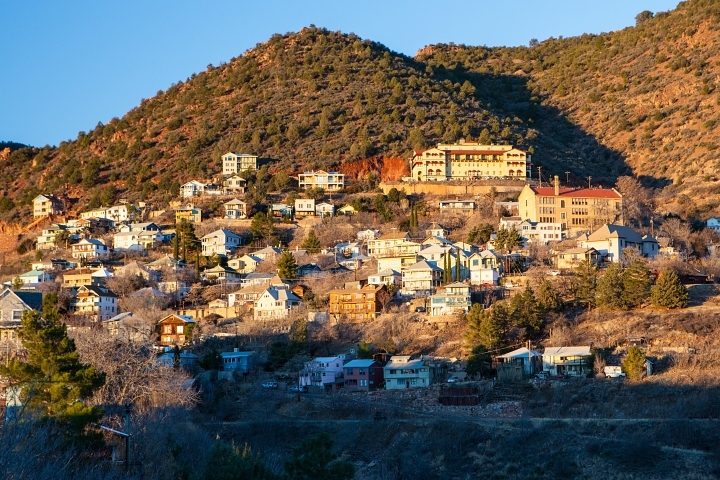
It was late afternoon and shadows from the town’s historic buildings were creeping down the side of the steep Black Hills of Yavapai County and stretching out into the flatter high desert of the Verde Valley below.
The structure with the longest shadow sat at the top of the town on Cleopatra Hill. Bathed in orange sunlight and a slight haze, Jerome’s Grand Hotel looked – well, just plain creepy this time of day.
This hotel has been called the most haunted hotel in America and has been featured on popular ghost hunting programs. And, I suppose it’s not surprising considering that before the Grand Hotel was a hotel, it was a hospital from 1926 to 1950 – for psychiatric patients.
During its hospital days, many deaths occurred from illness or injury. In fact, it’s believed that nearly 9,000 people died in the Jerome Grand Hotel during its previous incarnation as United Verde Hospital. As a hotel, guests report hearing coughing, labored breathing and even voices coming from empty rooms. Guests also report smells coming from rooms, such as flowers, dust, cigar smoke and whiskey. Others report light anomalies and the TVs turning themselves on with no explanation. The most amazing otherworldly sound is that of a gurney being pushed down the hallway banging through doors.
Many guests and hotel staff have heard and seen what appears to be a 4 or 5-year-old child running down the hallway on the third floor, sometimes crying or laughing. This child also likes to appear at the foot of the bed in various rooms, just staring at the bed’s occupant.
Guests also report the ghost of a cat on the third floor, often jumping onto a bed and walking around.
I have stayed at the hotel twice – and both times experienced non-ordinary phenomena. But more on that later …
Haunted Hospitals
Each year, more than 700,000 people die in U.S. hospitals alone. That total will surely be significantly elevated this year due to the coronavirus pandemic. Although they don’t talk about it publicly, anyone who has ever worked in a hospital knows what that means – more ghosts.
During my years as a medical writer I spent a lot of time with doctors. They were my sources and sometimes they even became my friends. I scrubbed in on operations, ate with them in their doctors only cafeterias, chatted in their lounges and even had drinks with them. Doctors for the most part are closed lipped stoic types that don’t venture off the tried and true ways of reality. But once they trust you and know you aren’t going to write anything embarrassing about them, they open up and tell you things of a paranormal nature.
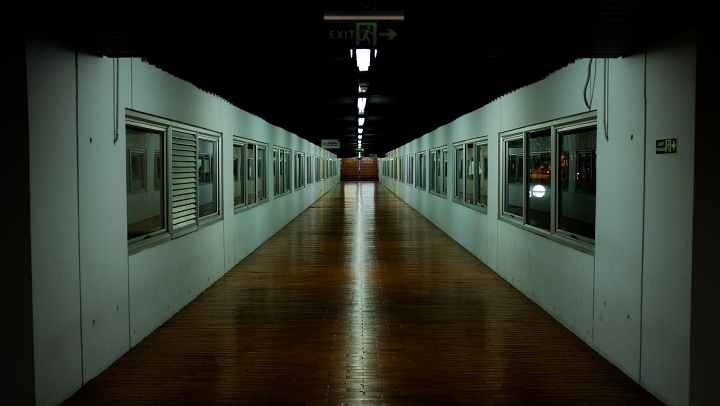
For example, just about every hospital has areas that nurses and other staff avoid due to the unsettling sensations they experience as well as catching fleeting shadows or shapes out of the corners of their eyes. These areas could be supply closets, patients’ rooms, hallways or bathrooms.
It’s not uncommon for doctors that perform life and death operations to have at least one extraordinary experience regarding patients that died on the operating table and then were resuscitated. Invariably patients with near death experiences can recall every detail of their operation as well as report on other activities around the hospital at the same time they were “technically dead.” Another common characteristic: Those that died and had their hearts restarted generally were not happy about being pulled back into their decimated bodies.
Of course there’s no empirical way to prove that a hospital’s ghost count increases during a pandemic, but from the Black Plague to COVID-19, hospitals where the most patients die seem to leave a substantial ghost trail in their wake.
Take the Waverly Hills Sanatorium in Louisville, Kentucky. This was the scene of a tuberculosis epidemic in 1926. Treatments at that time varied from balloon implants in the lungs to the removal of ribs and chest muscle to allow for lung expansion. When the treatments didn’t work (which was almost always), the facility jettisoned deceased patients down a 500-foot tunnel, which allowed personnel to discreetly whisk away the bodies by train.
Like Jerome’s Grand Hotel, Waverly has now been converted to a paranormal tourist attraction. Visitors claim they become queasy, feel weird vibes and sometimes have hair stand up on their arms in one particular area of the former hospital – the tunnel area that served as a body shoot.
The 1918 Spanish flu pandemic produced the greatest influenza death total killing an estimated 675,000 Americans and more than 50 million people globally. As with COVID-19, hospital staff suffered in the extreme with one old newspaper account reporting that nurses fell like ninepins.
Los Angeles was especially hit hard with official death tolls near 4,000 – but most likely much higher. The former Linda Vista Hospital had its share of death from the pandemic. For many years after the pandemic, hospital staff and visitors reported thousands of anomalies.
These include water spigots turning themselves on and off or baby hands touching them when there was no one around.
After the hospital closed it was sometimes used as a backdrop for Hollywood productions including the pilot episode of “ER.” During these productions, the hospital’s haunted reputation grew.
Reports of unexplained phenomena came from overnight security and production crews. Darting shadows, cries in the night and unexplained humming were all experienced by those working on the Linda Vista grounds. Many claim to have been touched and pushed by these unseen forces.
Three spirits in particular have been sighted on multiple occasions: A little girl lurks in the surgical room; a young woman paces the hallways of the third floor; and the spirit of an orderly still makes his daily rounds.
Talkin’ Ghosts
The hospital staff code of silence on the topic of ghosts is a lot like the airlines telling pilots to remain mum on UFOs – this kind of talk just isn’t good for business.However, when pilots are no longer pilots and nurses are no longer nurses, they can become quite chatty on these formerly forbidden subjects.
For example, Eric Redding’s Thought Calendar has a report titled “49 Real Nurses Share the Terrifying Hospital Ghost Stories That Scared Them to Death.”
I like No. 39:
A certified nursing assistant (CNA) tells the story of checking into her night shift job and being told by another nurse about “the creepiest thing” that happened a few hours earlier. A patient had abruptly died in one of the hospital rooms. That room was cleaned and quickly occupied by a second patient who had coded and pronounced dead but then was resuscitated. When that patient awoke he complained about being in that particular room because there was a man starring at him, a man who was very worried about his dog because the dog didn’t know he was dead.
The nurse asked the new occupant of the room to describe the man who was worried about his dog. He proceeded to describe (in detail) the patient who had died in that room a little earlier.
Around 3 a.m. the CNA and the nurse are sitting at the nurse’s station playing YouTube videos. Suddenly they hear a dog barking. They went to check it out and, yes, the barking was coming from the same room as the patient who was worried about his dog.
In the words of the CNA, she and her nurse friend simultaneously shit themselves.
No. 1 is also interesting, told by a nurse who was new to the hospital. One day she decided to take a shortcut to the ER through deserted hallways in an area that used to be the pediatric wing of the hospital but had become a corridor of empty rooms full of broken equipment and beds.
As she reached the old nurses’ station she saw a little girl with big pigtails, wearing a brown dress, white shoes and holding a teddy bear. The new nurse thought perhaps she was a family member who had walked away from the day surgery waiting room. Concerned, the new nurse walked over to the little girl with the intent of bringing her back upstairs with her. But as she went to grab the little girl’s hand, she vanished.
The shocked nurse rushed to the elevator and made a beeline to the nurse’s station in ER where, white as a sheet, she babbled about what had just happened. An older nurse listened patiently, then calmly said, “Oh, you saw the little girl ghost. She’s been around here for years.”
The new nurse then learned that the ghost she saw really got around the hospital sometimes ducking in and out of patient rooms and peeking around curtains. One night, a whole row of patients were yelling about the little girl because she was running around in their rooms.
An inordinate number of ghost sightings occur in parochial hospitals. St. Michael’s hospital in Toronto had so many paranormal encounters that they became the subject of a local newsletter. One of the collected stories was about a hospital staff member who did not believe in ghosts. Employed in the hospital’s IT department he was working alone one Saturday replacing a computer in the Medical Media Centre. As he was leaving he realized he had left something behind so he returned to the work area. As the employee started to pick up the forgotten item, he heard papers rustling loudly behind him. He turned to see what the noise was, and, as he did, something walked through him.
To say the incident rattled his cage would be a gross understatement. He got out of that office as fast as he could. On the way out he ran into a member of the hospital’s cleaning staff. She asked him if he was OK. He said no, and told her what had just happened. She listened then told him that something similar happened to her in that same office. One day she was watering a plant “when it began to move and shake vigorously.”
From that moment on, the IT employee never doubted the existence of ghosts. He also refused to work in that area of the hospital by himself.
Ghost Check
Surveys indicate that about 60% of Americans have had a paranormal experience that may have involved a ghost. As with the St. Michael’s IT employee, an up close and personal encounter with paranormal activity is a major factor to whether you believe – or you don’t.
While I have always sensed the presence of unseen entities, I didn’t have my first face to face ghost experience until I was 45 years old. I was living alone at the time in a two story Victorian-style house in Chandler, Arizona. Around midnight, a rare lightning and thunderstorm moved into the area awakening me from a deep sleep.
I sat up in bed with the intent of closing the bedroom window – and found myself inches away from something I can only describe as a faceless woman with glowing luminescent hair. Before I could even consider what I was looking at, this luminescent being reached back and hurled at me what appeared to be a luminescent pie.
I immediately reacted and fell back on the bed to avoid being hit. A moment later the glowing being vanished.
Since then I have had several other non-ordinary ghostly experiences involving people, pets, bodiless voices and other things.
One of those “other things” occurred on my first visit to Jerome’s former psychiatric hospital, the Grand Hotel. This place reeks of an ambiance ripe for abnormalities even though it has been converted into a hotel. There is still plenty of reminders that this hotel was once a stronghold for preventing people from leaving, such as a series of heavy doors guests must unlock in order to reach their rooms.
Parts of the hotel are firmly stuck in the past; the original Otis elevator still works, steam heat is used in some areas, and there’s even a working telephone switchboard.
I first stayed in the hotel in 2010. Given the reputation of the place and my sensitivity to non-ordinary reality, I was apprehensive over the possibilities I might encounter during the night. But to my amazement, nothing happened. In fact I was very comfortable and felt cared for as if I had been tucked in.
I slept soundly.
In the morning while eating breakfast in the hotel’s somewhat dreary Asylum restaurant, I mentioned how well I had slept to an employee of the hotel. He wasn’t surprised and said many of their guests reported the same sensation of being taken care of by a kind nurse.
After breakfast I went back to my room (unlocking several doors to get there) to brush my teeth and pack my things. After about 30 minutes, it suddenly occurred to me that I had been mindlessly humming the same song over and over again. The song was “Frere Jacques,” a tune that would have been popular during the time period when the Grand Hotel was a grand psychiatric institution.
I was familiar with the song but I had never hummed it – or any song continuously for a half-hour or more. Best I could determine, some kind of transference had taken place.
On my second visit to the hotel, I was with a friend. After breakfast we trudged up the stairs to the first round of locked doors. I noticed an elderly woman cleaning the glass on the other side of the door. As I was unlocking the door I told my friend to be careful of the cleaning woman.
She said, “What cleaning woman?”
I looked back up and the woman had disappeared. I opened the doors and the hallway was empty.
Why Ghosts Like Hospitals
No one really knows what a ghost is but if you’ve ever encountered one you’re pretty sure these non-ordinary entities exist.
Hospitals are of course houses of fever, trauma and crisis. These states – exacerbated by treatment itself (surgery, drugs, immobility and so on) – can result in extreme emotional distress for both the patient and loved ones. It’s probably not a coincidence that an unusual number of ghost sightings are reported around other emotion wrenching tableaus such as battlefields or grisly homicide scenes.
There are some interesting theories about ghosts and extreme emotional states – often involving quantum physics.
In their book “Ghosts, Specters and Haunted Places,” authors Michael Pye and Kristen Dailey point out that from quantum physics we know that time is a relative thing and that it passes at different rates in relationship to the observer. On some level, the past to you is the future to someone else in the universe and vice versa. In essence, every single moment you exist you leave an imprint of yourself like the slime trail of a snail. In fact, our lives are actually a continuum of energy.
Some life moments stand out more strongly than others, especially at times when strong emotional energy is exuded. It can be a split second or a small 20 second clip like from a video. Is it possible that during moments like these your energy becomes drenched in your surroundings and that the frequency of that unique imprint resonates with others (perhaps in their future) who are able to tune into it (in other words, those who are sensitive to paranormal activity).
Additionally, environmental conditions such as temperature and humidity or even geomagnetic or solar cycles might also impact how easily these subtle impressions present themselves.
Of course this doesn’t explain the overwhelming number of individuals who suffer agonizing deaths who don’t appear to anyone as a ghost.
A lot has been written about “Einstein’s ghosts.” Albert Einstein wanted physical reality to be intelligible, independent of any random actions. If two events separated in space have some sort of correlation, there must be a reasonable explanation for it. By reasonable, Einstein meant objects have physical properties that depend on their position and that they can somehow exchange information that propagates through space. They should be able to communicate at speeds at, or slower than, light. Otherwise, Einstein said, it would be like having “spooky actions at a distance.”
Recent experiments have confirmed that the realist expectation failed; in quantum mechanical systems (small things like atoms, material particles and photons, the particles of light) spooky action at a distance is a reality. Objects, even if separated by large distances, form an indissoluble unit with one responding to the other in ways that defy local explanations with signals traveling at or slower than light. This nonlocality, to say the least, is profoundly mysterious.
Takeaway: Science doesn’t know everything.
In contemporary culture, the word ghost normally refers to something nonphysical. But as Pye and Dalley point out, perhaps it’s incorrect to think of ghosts as intangible things. Perhaps it’s more accurate to say there is no such thing as the nonphysical, but rather there are simply different levels of physicality. Two things are physical to each other if they resonate within a similar electromagnetic frequency range.
For example, you can pick up a baseball because you and the baseball exist in the same frequency range. But you cannot feel radio waves even though you are bombarded by them. This is due to the fact that you and the radio waves are resonating at very difference electromagnetic frequencies. Yet a device like a radio specially tuned to interact with radio waves can turn their energy into sound.
Could it be that ghosts more or less appear physical depending on these varying relationships? In this way, it’s possible that certain individuals are able to perceive and interact with a ghost while other individuals cannot.
It’s also been noted for several centuries that ghosts tend to be more physical to those in fragile health, such as the patient who coded and was brought back to be confronted by a recent ghost concerned about his dog. Are the near dead suffering from a state of delirium or experiencing a shift in the electromagnetic spectrum that brings their frequency more in line with a ghost’s?
The problem with the quantum physics explanation and most others is that current ideas about ghosts don’t take into consideration all the variables of form: Not just human-shaped, but mists, smells, sound, luminescent lights and voices without bodies whispering into our ears.
While hospitals are easy marks for noting ghost activity, maybe similar paranormal occurrences are happening in our own homes but we fail to take notice due to our busy lives, which separate us from our homes for many hours a day.
According to paranormal researcher John E.L. Tenney, haunted house reports are on the rise during the pandemic because more people are at home taking notice of their environment.
The New York Times also noticed the uptick and interviewed Tenney, former host of TV’s “Ghost Stalkers.” According to Tenney, he’s now getting 10 calls a week regarding house hauntings compared to just a couple a month before the coronavirus. Tenney said the reports include a little bit of everything from typical knocks and footsteps in the hallway, to some very new, strange occurrences, like people hearing whispered voices through their TVs or getting text messages from long deceased friends and relatives.
For me, it’s unlikely I will make another visit to Jerome’s Grand Hotel. I don’t have anything against ghosts, but still, I find their presence disturbing. I would much rather spend a sunny day outside enjoying the natural beauty of the Verde Valley’s red rocks without a ghost floating over them …
Winking at me.
Great article. Now I know more than I ever wanted to about ghosts!