


My strange day began with an email sent to me by a friend, Belinda Seabrook.
In the email was a story and video link that appeared in The Guardian. The story and the link were about how the Pentagon had released three formerly classified videos of UFOs (what the Pentagon calls “unidentified aerial phenomena”) taken by U.S. Navy pilots during training flights.
The clips showed oblong objects moving through the sky at incredible speeds and agility. Pilots could be heard admiring the sudden movements and midair rotation of the UFOs as they flew into a substantial headwind.
There are better videos of UFOs, such as the those taken during the Mexico City flap in the mid-1990s, but the significance of the Pentagon’s actions is considerable and I am surprised more wasn’t made of it. Essentially, the U.S. government after 70 years of poo-pooing UFO sightings was finally admitting that yes, UFOs are real.
Having had my own UFO encounters over the years, including a possible alien abduction in a Costa Rican rainforest in 2011, I needed no convincing validating the existence of UFOs. But the email my friend sent me brought back a memory of someone I came to admire and regard as one of the most courageous human beings I ever met.
My Close Encounter With J. Allen Hynek
I met astronomer and professor J. Allen Hynek for lunch at the old Backstage restaurant in Scottsdale’s Civic Plaza. He was in his 70s at the time, somewhat frail but still with a sharp mind as he thoughtfully talked between puffs of his iconic pipe.
I was a journalist for the Arizona Republic newspaper at the time, and Hynek, scientist turned ufologist, had called me on the phone a week earlier inquiring about a story I had written about Childs, Arizona, a small, isolated community north of Phoenix near Black Canyon City. He was interested in the story because of the detailed accounts of the people who lived in Childs regarding multiple UFO sightings.
Hynek wanted me to help him arrange for a meeting with the principles in the community to discuss the UFO activity. But the community wanted nothing to do with Hynek due to the incessant harassment the residents of Childs received for opening up about the UFO invasion.
Hynek had more or less retired when I met him. He and his wife had moved to Arizona and purchased a modest home in one of Scottsdale’s older neighborhoods. He had dropped out of the limelight, but some 20 years earlier he had been at the center of one of the most frenetic UFO flaps in the history of the planet. Back in the mid-60s it would have been difficult to pick up a newspaper or turn on the evening news and not hear the name of J. Allen Hynek.
Hynek had been hired by the U.S. Air Force to discredit UFO sightings.
His association with the military began in the late 40s when Hynek, a 37-year-old director at Ohio State University’s McMillin Observatory, was approached by the Air Force to come up with rational reasons why so many people were on edge about mysterious objects in the skies. The Air Force reasoned that a scientist as their frontman discrediting UFO sightings would carry more weight than the military saying UFOs weren’t real.

Interestingly, the Air Force refused to use the term “unidentified flying object,” so the most enigmatic cases were simply referred to a “Unidentified.”
The Air Force called their initial investigation Project Sign followed up by Project Grudge.
Hynek had worked for the government during the war, developing new defense technologies like the first radio-controlled fuse, so he already had a high security clearance and was a natural go-to.
According to Hynek, he had barely heard of UFOs in 1948 and, like every other scientist he knew, assumed they were nonsense.
Hynek treated his reports for the Air Force as a kind of side gig.
At the conclusion of Project Grudge, the Air Force announced that the UFO phenomenon posed no danger to the United States and was the result of one of several factors, such as:
- Mass hysteria
- Deliberate hoaxes
- Mental illness
- Or misinterpreted conventional objects
But the UFO sightings continued, and the Air Force (with Hynek’s scientific assistance) was forced to open another project to look into the disturbances. The Air Force called this Project Blue Book.
Meanwhile, Hynek eventually left his job at Ohio State University and moved to Northwestern University in Evanston, Illinois, to chair its astronomy department. He was, therefore, in the perfect spot to investigate the onslaught of UFO sightings when all hell broke out in Michigan in 1966.
It began in March of that year with a sighting over a farm in Dexter. Lights were seen hovering and then zipping across the sky. Reports came in from all over the area. One Washtenaw County sheriff deputy was quoted as calling the objects, whatever they were, “the weirdest things I’ve ever seen.”
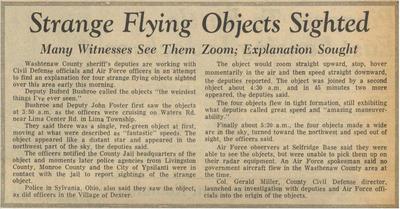
Similar fast moving lights were seen across the border in Ohio. All in all, hundreds of individuals reported UFO activity in the same week. And, there was Hynek, in the middle of the UFO hotbed, calmly sucking on his pipe and dismissing every sighting giving it a rational, scientific explanation.
Hynek’s most famous UFO explanation “It’s just swamp gas” became a punchline for newspaper cartoonists and stand-ups. Even Gerald Ford, then a Michigan Congressman, declared that people deserved a better explanation than something as laughable as “swamp gas.”
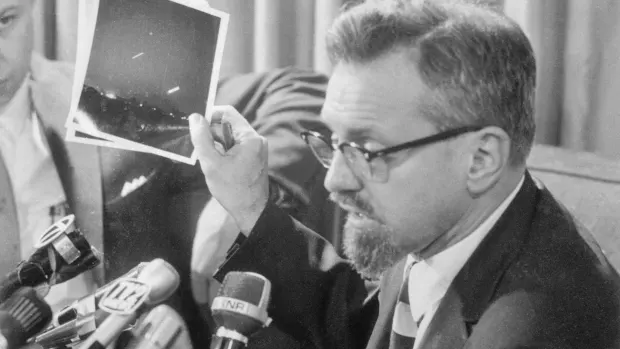
It wasn’t long before UFO mania had swept the nation. UFO reports were pouring in from all over the country. This was the era that sparked Hollywood’s love-affair with aliens, leading to blockbusters like “E.T. the Extra Terrestrial” and “Close Encounters of the Third Kind.” Walter Cronkite anchored a 1966 CBS report titled, “UFO: Friend, Foe or Fantasy?” which featured the Dexter incident.
But like most UFO flaps, the one in Michigan also subsided as did UFO sightings in general – so much so that in 1969 the Air Force closed out Project Blue Book.
Hynek, on the other hand, couldn’t let it go. In fact, he did an about face. The true scientist emerged. He had suspected for some time that UFOs were real, but he couldn’t say anything due to his association with the Air Force.
Hynek began to reevaluate the UFO reports he had routinely dismissed under pressure from the Air Force. He also began to look at new sightings around the world with the critical eye of the researcher rather than the naysayer. He founded the Center for UFO Studies in 1973 in order to collect and evaluate UFO reports.
In 1972, Hynek published “The UFO Experience,” which introduced Hynek’s classifications of UFO incidents he called Close Encounters.
Close Encounters of the First Kind were UFOs seen at a close enough range to make out some details. A Close Encounter of the Second Kind was when a UFO caused physical effect, such as burning grass in a field.

The most dramatic of Hynek’s classifications, Close Encounters of the Third Kind, was when witnesses reported seeing occupants in or near a UFO. This classification went on to become the title of a blockbuster Steven Spielberg movie released in 1977 – a film where Hynek appeared in a cameo role at the end as an awestruck scientist when an alien craft lands in close view.
UFOs Are Really Real — Really
During my lunch with Hynek he kept coming back to the same topic, how he had no doubt that UFOs were real, although what they were exactly he did not know. He said he finally reached that conclusion from the large number of credible witnesses (about 20%) he had interviewed whom he believed had really seen something not of this world.
“While the scientific method is important, it’s equally important for science to keep an open mind,” Hynek said. “Given the one hundred billion galaxies in the known universe, the odds are good we don’t know everything there is to know about the universe.
“There could be aspects of physics we haven’t come upon yet.”
After lunch we drove over to Hynek’s house where he showed me a room filled with meticulously labeled 8-tracks from interviews had had conducted with people who claimed to see a UFO. There were also transcripts and every other known means of documentation at that time – the complete oeuvre of J. Allen Hynek the ufologist.
As I was about to leave, I asked Hynek if he had any regrets in his career. He took a few puffs of his pipe, and when the smoke cleared, he answered:
“My biggest regret is that I never saw a UFO. I really wish I could see one.”
It’s unlikely Hynek’s wish came true. He died of a brain tumor a year later. He was 75.
What Is the Pentagon Saying?
I really liked J. Allen Hynek. He was both serious and sincere – a gentle, intelligent soul, thoughtful and void of ego. To me he was the epitome of a true scientist. While initially approaching the UFO phenomenon with the scientist’s skepticism and objectivity, his strong observational skills led him to approach UFO sightings with a driving empirical curiosity.
There was that, and then there was his standing up to the Air Force after Project Blue Book shut down. His new voice documenting the credibility of UFO sightings did not cast the Air Force in the best light. He was essentially admitting that the Air Force hired him as their spin doctor. He was essentially telling the world that UFOs were real despite the military’s attempts to scream otherwise.
That took a pair.

Most importantly, while Hynek couldn’t solve the enigma of UFOs, he made trying to solve the mystery a legitimate scientific pursuit.
Which brings me back to the UFO videos released by the Pentagon. For some reason I found this very disturbing. The fact that the videos were released at the height of the COVID-19 pandemic, made me think of this:
As a medical writer for many years, I was not particularly surprised over the rapid global spread of the coronavirus. Due to the eroding effectiveness of antibiotics, climate change, overburdened local health systems and a burgeoning global population into new geographical regions, epidemiologists had been expecting something along the lines of COVID-19 for a very long time.
So the question is: Are governments also expecting something big in the UFO arena? Is the admission of UFOs by the Pentagon the first step in preparing the populous for a life-altering revelation?
Just under half of Americans believe UFOs exist and have visited the Earth, according to a recent Ipsos poll. This would indicate that Earth’s human inhabitants are much more likely to accept an extraterrestrial presence now than in the 1940s. Therefore it’s possible governments feel that the time is right to come clean with the public after more than half a century (from Roswell to Area 51) of remaining mute on the topic in order to prevent mass panic.

It is odd how many of the modern presidents (including Jimmy Carter who saw a UFO) vowed to disclose classified UFO information when they were running for the office only to back off once they were elected.
Could the information they encountered in those files have been so shocking that the presidents agreed it was better to keep quiet than unravel society as we know it?
Like the epidemiologist preparing us for a virulent global virus, is the Pentagon now releasing videos of UFOs as a means to soften the bombshell that we are not alone, and perhaps never really have been?
I think this is an important area to monitor. Watch for a new feature in Strange Days: The Blog that will be following the situation.
Nice story. I remember you, Thomas, when you visited Childs for the Arizona Magazine. You were the only person in the media who treated our UFO sightings with respect. Thank you.